


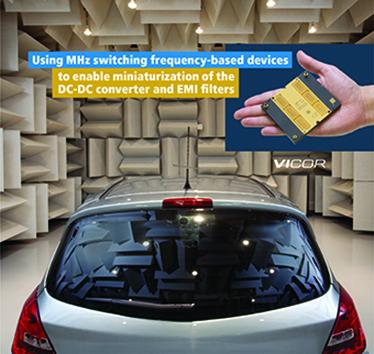
MHz switching frequency-based devices enable miniaturization of the DC-DC converter and EMI filters
Achieving EMI conducted emission compliance for automobiles with a single stage filter. By Nicola Rosano, Sr. Strategic FA/System Engineer at Vicor
More details...

A full brick package developed by TDK-Lambda, the PF1500B-360, is for high voltage distributed power architectures
More details...
In power electronics, stress on power modules is constantly increasing. More compact designs, higher current densities, and the use of silicon carbide (SiC) or gallium nitride (GaN) semiconductors lead to significantly higher thermal and electrical stress conditions. Material interfaces, or triple points, between metal, ceramic, and encapsulant are particularly critical. Stresses, voids, and adhesion issues arise at these interfaces, which can lead to delamination or electrical failures over time.
In practice, these effects do not usually manifest immediately, but rather develop gradually over temperature cycles, electrical load cycling, and mechanical stresses during operation. This underscores the importance of thorough surface preparation, which improves individual process steps and ensures the overall quality of the bond. Plasma technology comes into play precisely at this interface between material, process, and long-term reliability. At PCIM, Plasmatreat will showcase various plasma systems and solutions tailored to the specific requirements of power module manufacturing, including cleaning, activation, and oxide reduction.
Low-pressure Plasma for Complex Geometries
In Hall 7 at Booth 169, Plasmatreat will showcase a system from the new AURORA-Plasma product series, among other things. With AURORA-Plasma, Plasmatreat is expanding its technology portfolio specifically for applications requiring the highest levels of homogeneity and flexibility. The system uses a multi-frequency approach to precisely adapt the plasma treatment to the material, geometry, and process requirements. This feature allows for significantly finer control of the plasma’s energy input and adaptation to different material reactions. Consequently, sensitive substrates can undergo the same reliable process as materials capable of withstanding high thermal loads. At the same time, particularly uniform activation is achieved across complex 3D structures, significantly improving the reproducibility of critical downstream processes.
Low-pressure plasma is particularly effective with complex components, densely populated power modules, and sensitive composite materials. The surfaces are uniformly activated without shadow effects or local inhomogeneities. These stable, reproducible conditions are ideal for subsequent processes such as potting, coating, or bonding.
In addition to the new low-pressure solution, Openair-Plasma remains essential to industrial power module manufacturing. This process operates at atmospheric pressure and can be integrated directly into existing production lines. Surfaces are cleaned dry and selectively without the use of additional chemicals. Organic residues are removed and oxide layers are reduced inline.
This enables surface pretreatments to be performed directly before critical steps in the process, such as die bonding, wire bonding, underfill, or encapsulation. In-line plasma activation changes surface properties and creates stable conditions for reliable wetting and adhesion. At the same time, inline integration enables high cycle rates, as well as fully automated, reproducible process control.
One of the key challenges in power module manufacturing is reliably controlling oxide layers on metal surfaces. These layers directly impact the quality of electrical and mechanical connections and can significantly shorten the service life of components. At PCIM, Plasmatreat is showcasing its REDOX-Tool, which reduces metal oxides on copper and aluminum surfaces inline. This technology precisely, dryly, and selectively removes oxide layers without the use of flux or wet chemical processes. It optimally prepares contact surfaces for subsequent bonding processes while reducing the number of steps in the process.
The combination of atmospheric and low-pressure technologies allows for the specific addressing of different requirements within power module manufacturing. Atmospheric pressure plasma is designed for inline capability, speed, and direct, automated integration. In contrast, the low-pressure solution offers maximum homogeneity and flexibility for complex geometries and sensitive materials. Both technologies ensure compliance with defined quality standards and reproducibility of treatment through various quality assurance modules.
Thus, Plasmatreat addresses not only individual process steps, but also the entire surface preparation process along the modern electronics manufacturing value chain. These technologies help stabilize process windows, reduce scrap, and increase the long-term reliability of power modules. "Surface quality is a key factor in determining the reliability of modern power modules," explains Nico Coenen Global Director Electronics Market
at Plasmatreat. "With our plasma portfolio, we enable manufacturers to achieve stable, reproducible processes—from the initial cleaning step to the final bonding."
Plasmatreat will demonstrate how these solutions can be integrated into specific manufacturing environments at PCIM Europe in Hall 7, Booth 169.
For more information, please visit: www.plasmatreat.com
(approx. 7,000 characters with spaces)
View PDF
| Privacy Policy | Site Map | © Copyright DFA Media
| Web design by Immersive Media