


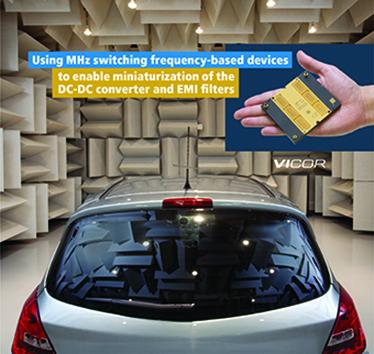
MHz switching frequency-based devices enable miniaturization of the DC-DC converter and EMI filters
Achieving EMI conducted emission compliance for automobiles with a single stage filter. By Nicola Rosano, Sr. Strategic FA/System Engineer at Vicor
More details...

A full brick package developed by TDK-Lambda, the PF1500B-360, is for high voltage distributed power architectures
More details...
The company says the new 2300 V class devices support DC-link voltages of up to 1500 V, addressing the industry trend toward higher system voltages. The modules are available in several variants, offering on-resistance (RDS(on)) values ranging from 1 mΩ to 2 mΩ and isolation voltages of 4 kV or 6 kV. By leveraging silicon carbide (SiC) technology, the devices can reduce both switching and conduction losses compared to conventional silicon-based solutions. This enables inverters to achieve higher efficiency and power density, or to operate at higher switching frequencies to reduce harmonics and system size. The new XHP 2 CoolSiC MOSFET modules are well suited for renewable energy applications, including wind, photovoltaic and battery storage systems.
Implemented in the XHP 2 package, the modules feature symmetrical switching behaviour for easy paralleling in large power converters and offer a standardised platform that enables developers to balance efficiency and performance according to application requirements. All variants integrate Infineon’s proven .XT interconnection technology, enhancing reliability and extending operational lifetime. The modules are also available with a pre-applied thermal interface material, simplifying assembly while supporting consistent thermal performance.
These characteristics translate into measurable system-level benefits. In a wind power demonstration system, a power density of 300 kW/L was achieved, while tests in battery storage systems showed semiconductor losses of less than 0.7 percent of the output power. With this portfolio expansion, Infineon supports scalable solutions for next-generation high-voltage power systems across a wide range of renewable energy applications.
View PDF
| Privacy Policy | Site Map | © Copyright DFA Media
| Web design by Immersive Media