


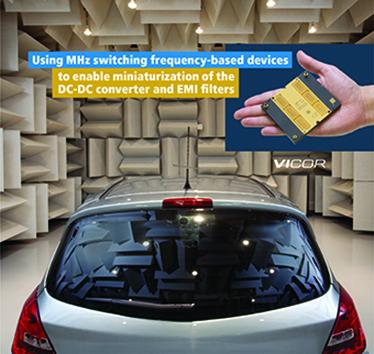
MHz switching frequency-based devices enable miniaturization of the DC-DC converter and EMI filters
Achieving EMI conducted emission compliance for automobiles with a single stage filter. By Nicola Rosano, Sr. Strategic FA/System Engineer at Vicor
More details...

A full brick package developed by TDK-Lambda, the PF1500B-360, is for high voltage distributed power architectures
More details...
TI says its scalable TDA5 high-performance computing system-on-a-chip (SoC) family offers power- and safety-optimised processing and edge artificial intelligence (AI) that supports up to Society of Automotive Engineers Level 3 vehicle autonomy. TI says it also unveiled the AWR2188, a single-chip, eight-by-eight 4D imaging radar transceiver, to help engineers simplify high resolution radar systems. These devices, alongside the DP83TD555J-Q1 10BASE-T1S Ethernet physical layer (PHY), join TI’s broader automotive portfolio for next-generation advanced driver assistance systems (ADAS) and software-defined vehicles (SDVs). TI is debuting these products at CES 2026, Jan. 6-9, in Las Vegas, Nevada.
High-performance compute SoCs enable safe, scalable AI across vehicle models
To enhance safety and autonomy in next-generation vehicles, automakers are adopting central computing systems that support AI and sensor fusion for real-time decision-making. Designed for high-performance computing, TI says its TDA5 SoC family offers edge AI acceleration from 10 trillion operations per second (TOPS) to 1200 TOPS with power efficiency beyond 24 TOPS/W. This scalability, enabled by their chiplet-ready design with Universal Chiplet Interconnect Express interface technology, allows designers to implement different feature sets and support up to Level 3 autonomous driving using a single portfolio. Building on over two decades of experience in automotive processing, the family expands the performance of TI’s existing portfolio to enable automakers to centralise their computing architectures and process advanced AI models.
By integrating the latest generation of TI’s C7 neural processing unit (NPU), TDA5 SoCs can provide up to 12 times the AI computing of previous generations with similar power consumption, eliminating the need for costly thermal solutions. This performance supports billions of parameters within language models and transformer networks, increasing in-vehicle intelligence while maintaining cross-domain functionality. The family features the latest Arm Cortex-A720AE cores, allowing automakers to integrate more safety, security and computing applications.
TDA5 SoCs reduce system complexity and costs by supporting cross-domain fusion of ADAS, in-vehicle infotainment and gateway systems within a single chip. Their safety-first architecture further simplifies systems by helping automakers meet Automotive Safety Integrity Level D safety standards without external components.
To simplify complex vehicle software management, TI says it is partnering with Synopsys to provide a Virtualizer development kit for TDA5 SoCs. The kit’s digital twin capabilities help engineers accelerate time-to-market for their SDVs by up to 12 months.
To learn more, read the technical article, “Why scalable high-performance SoCs are the future of autonomous vehicles.”
10BASE-T1S technology extends Ethernet to vehicle edge nodes
The acceleration toward SDVs and higher levels of autonomy is prompting a fundamental shift in subsystem architectures. Ethernet is an important enabler for this evolution, as it allows systems to collect and transmit more data across vehicle zones in real time through a simple, unified network architecture. TI’s new DP83TD555J-Q1 10BASE-T1S Ethernet Serial Peripheral Interface PHY with an integrated media access controller offers nanosecond time synchronisation, industry-leading reliability and Power over Data Line capabilities. These features enable engineers to extend high-performance Ethernet to vehicle edge nodes while reducing cable design complexity and costs.
With TI's end-to-end system offering, which includes technologies for advanced sensing, reliable in-vehicle networking and efficient AI processing, automakers can develop systems that improve safety and automation levels across different vehicle models.
To learn more, read the company blog, “The semiconductor technology shaping the autonomous driving experience.”
View PDF
| Privacy Policy | Site Map | © Copyright DFA Media
| Web design by Immersive Media